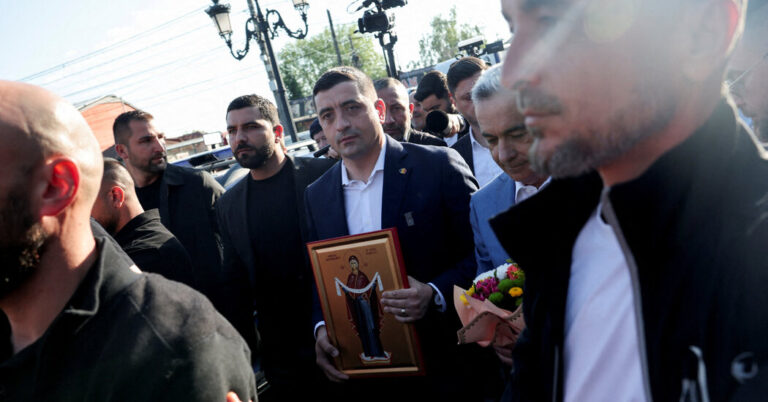
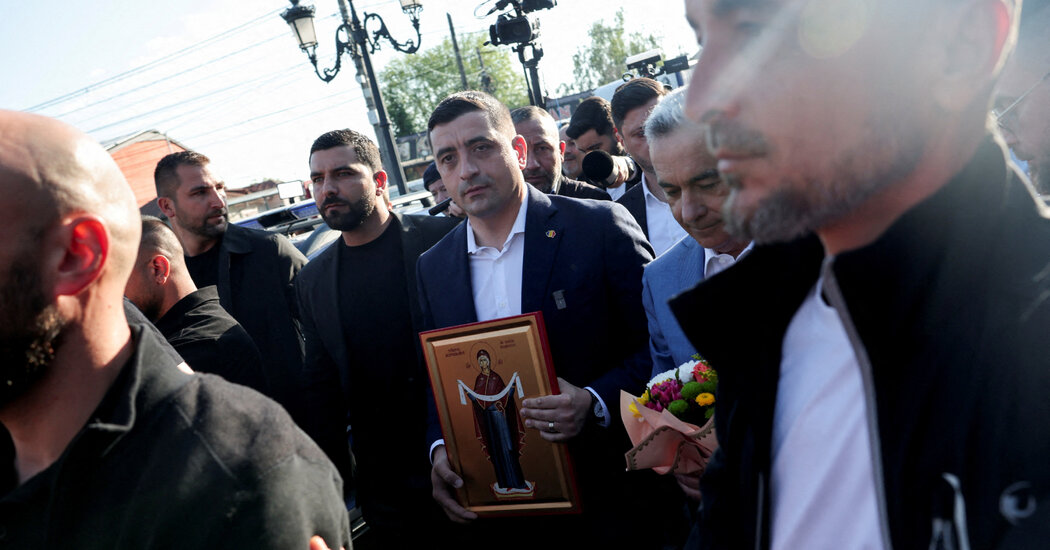
George Simion, a right -wing nationalist who promised to “make Romania big again”, won the first round of the presidential elections of his country on Sunday, contrasting the recent trend of the voters who punish the candidates seen as friendlies against President Trump.
With beyond 98 percent of the votes expressed in Romania, Mr. Simion was much further on compared to the 10 rival candidates, obtaining over 40 percent. A partial count of the votes of Romanians who live abroad, who generally tilt on the right, also gave a great advantage to Mr. Simion.
The results, although incomplete, have ensured Mr. Simion a slot in a outflow on May 18 against the probable finer of second place, Nicusor Dan, the center -center mayor of Bucharest, the capital of Romania.
Unlike the voters in Canada and Australia who in the recent elections have favored the parties openly contrary to Mr. Trump, the Romanians, supporting Mr. Simion, rewarded one of the most vocal admirers of the Maga Movement.
Romanian voters also gave a strong reproach to a decision in December by the Constitutional Court of the country to cancel a first round of the presidential vote and to cancel the victory of Calin Georgescu, an ultra -nationalist. In February he was accused of various crimes, including illegal campaigns and involvement in the establishment of an organization “with a fascist, racist or xenophobic character”.
Mr. Georgescu, to whom the competition was prohibited in the reprogrammed vote, voted on Sunday together with Smion. Both men threw themselves as samples of Romanian ordinary against a corrupt plant.
Celebrating the results on Sunday evening, Mr. Simion declared the elections a “victory for Romanian dignity”.
“Despite the obstacles,” he said, “despite the manipulation, despite a press paid to diminish the United States day after day, the Romanians got up.”
Simion shares many of the opinions of Mr. Georgescu, including hostility towards the European Union and the opposition to military aid for Ukraine. A fixed appointment of Romanian politics for years, however, is much better – and is seen as a little more predictable – of Mr. Georgescu, an irregular figure inclined to mystical ruminations and to admire comments on past Romanian fascists.
Few Romanians had heard of Mr. Georgescu until he won the initial round of the vote after an increase in the support led by a mysterious flooding of videos on Tiktok in the last days of the countryside.
The Constitutional Court canceled his victory only two days before a December outflow vote according to which Georgescu had been well positioned to win. The Court said he wanted to “guarantee the correctness and legality of the electoral process”.
The intervention of the Court caused the road protests and complaints of the vice -president JD Vance that Europe was in “retreat” by democracy and freedom of speech. The sentence came after Romania's security service has released declassified intelligence relationships that indicated the possible Russian interference in the election campaign, but did not provide it for solid evidence.
The president of Romania has limited powers, but include the general command of the armed forces, a great voice in military spending and in the supervision of foreign policy. The control of economic and other policies is based on Parliament, in which the centrist forces have a restricted majority.
Andrada Lautaru Relationships contributed by Bucharest.